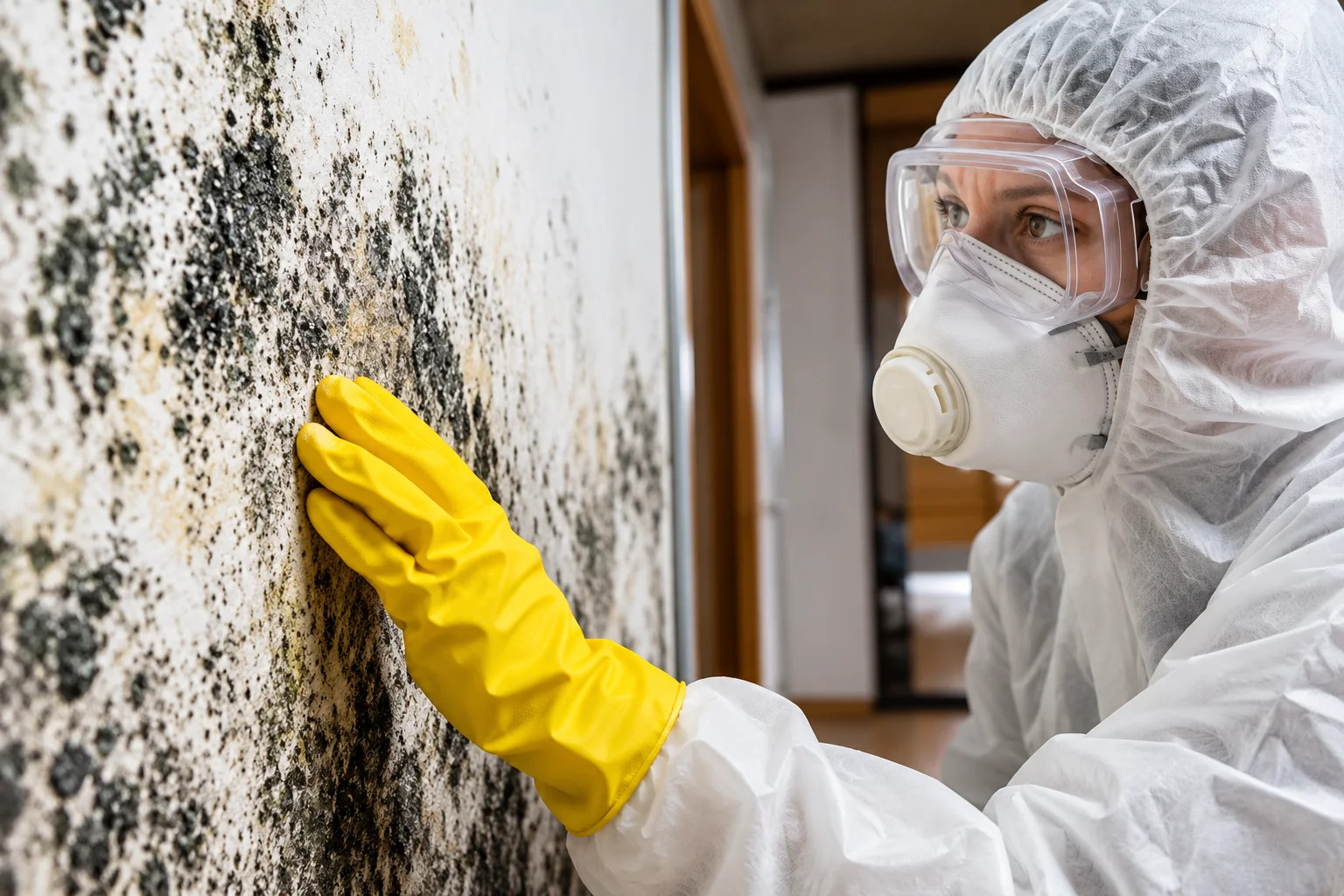
Mould specialist tools help professionals investigate moisture, inspect concealed areas, control airborne particles and manage drying during mould remediation.
Professional mould remediation involves more than removing visible growth. A specialist may need to determine where moisture is coming from, how far affected conditions extend, whether the work area needs containment and whether materials are sufficiently dry.
That requires different equipment at different stages of the job.
For homeowners considering professional remediation, or DIYers wondering why specialists carry so much equipment, understanding these tools provides a useful look behind the scenes.
Why Do Mould Specialists Need Specialised Tools?
Visible mould tells only part of the story.
A dark patch on plasterboard may be associated with surface condensation. It could also be connected to moisture within the wall, a plumbing leak or previous water damage.
Mould problems are relatively common in Australian housing. The Australian Institute of Health and Welfare reports that nearly 35% of people experienced problems with mould in their current home in 2022, based on the Australian Housing Conditions Dataset.
Before remediation begins, a specialist may need to establish:
- Where the moisture is coming from
- How far the affected area extends
- Whether surrounding materials are damp
- Whether mould could be present in concealed areas
- Whether the work area requires containment
- Which materials can be cleaned
- Which materials may require removal
- Whether drying conditions are improving
No single device answers all these questions. Different tools provide different pieces of information, which specialists can consider alongside the property history and visible conditions.
A simple way to understand the toolkit is by the role each type of equipment can play:
| Stage | Purpose | Examples of tools |
| Inspect | Examine visible and concealed conditions | Thermal imaging cameras, borescopes, inspection cameras |
| Measure | Assess moisture and humidity or collect samples | Moisture meters, hygrometers, air and surface sampling equipment |
| Control | Manage particles and isolate work areas | HEPA vacuums, air scrubbers, negative air machines, containment materials, PPE |
| Dry | Support and monitor drying | Dehumidifiers, air movers, moisture mapping equipment |
Some tools can contribute to more than one stage. Their value comes from using them for the right purpose and interpreting the information in context.
1. Moisture Meters
A moisture meter is one of the most useful tools during a mould and water-damage assessment.
It helps assess moisture conditions in building materials such as timber, plasterboard and other surfaces, depending on the instrument being used.
Two broad types are commonly encountered.
Pin-Type Moisture Meters
Pin meters use probes that make contact with the material.
They can help specialists take readings at specific points and compare moisture conditions between different locations.
Pinless Moisture Meters
Pinless meters use an electronic sensor to assess an area without inserting probes into the surface.
They can be useful for scanning larger sections of walls, floors or other materials for changes that warrant closer investigation.
Neither type directly detects mould. A moisture meter provides information about moisture conditions that can help guide the wider investigation.
2. Thermal Imaging Cameras
A thermal imaging camera displays variations in surface temperature.
These patterns can help an experienced operator identify locations that warrant closer investigation. For example, an unusual temperature pattern on a wall could provide a reason to take moisture readings in that area.
Thermal imaging does not allow a specialist to see mould through a wall. It also does not directly detect moisture.
Its value comes from highlighting temperature patterns that can be compared with physical observations and other measurements.
3. Hygrometers and Environmental Meters
Understanding the surrounding air can be important during mould assessment and drying.
A hygrometer measures relative humidity. More advanced environmental meters may also provide information such as temperature and other psychrometric measurements.
High indoor humidity can contribute to conditions favourable to mould growth, particularly where condensation or poor ventilation is involved.
Environmental measurements can also help remediation professionals assess drying conditions and monitor how those conditions change during a project.
4. Air Sampling Equipment
In some situations, a mould investigation may include air sampling.
Specialised pumps draw a controlled volume of air through or onto a sampling medium. The collected sample can then be submitted for appropriate laboratory analysis.
Air sampling may provide information about airborne fungal particles at the particular place and time the sample was collected.
However, an individual sample does not independently identify where a moisture problem is located or establish the extent of contamination throughout a building.
Sampling results are more useful when considered alongside inspection findings, building history and moisture information.
5. Surface Sampling Tools
Sometimes a specialist needs information from a particular surface.
Depending on the purpose of the assessment, surface sampling methods can include swabs, tape lifts or other appropriate collection techniques. Samples may then be examined or sent for laboratory analysis.
As with air sampling, results relate to the area sampled and need to be interpreted within the wider investigation.
6. Borescopes and Inspection Cameras
Some important areas in a mould investigation are difficult to see.
Wall cavities, cabinetry, ceiling spaces and other concealed locations may require closer inspection.
A borescope or inspection camera uses a small camera attached to a flexible or rigid probe. It can allow an inspector to examine certain confined areas through an existing or appropriately created access point.
Where conditions allow, this can help reduce unnecessary exploratory removal.
Access requirements and the suitability of invasive investigation still depend on the building and circumstances.
7. HEPA Vacuums
Once remediation begins, controlling fine particles becomes important.
Professional remediation work may use vacuums fitted with high-efficiency particulate air, or HEPA, filtration. These systems are designed to capture very small airborne particles passing through the filter.
HEPA vacuuming may form one part of a remediation process for appropriate surfaces and materials.
This equipment should not be confused with an ordinary household vacuum cleaner. Using unsuitable vacuum equipment on mould-contaminated material may redistribute particles instead of providing appropriate filtration.
8. Air Scrubbers
While HEPA vacuums can be used on appropriate surfaces and materials, air scrubbers filter air within the work environment.
An air scrubber draws air through filtration stages, often including HEPA filtration, before returning filtered air to the environment or managing it according to the remediation setup.
During appropriate remediation work, air scrubbers can assist with controlling airborne particulate levels within the work area.
The required equipment capacity and configuration depend on factors such as room size, containment design and the remediation process being undertaken.
9. Negative Air Machines
Where remediation involves disturbing affected materials, managing airflow can become part of the containment strategy.
A negative air machine can be used within a containment system to help maintain pressure conditions in a controlled work area.
The objective is to manage airflow so particles generated during remediation are less likely to migrate into unaffected areas.
This highlights an important difference between professional remediation and ordinary household cleaning: the specialist considers both the affected material and how particles may move during the work.
10. Containment Materials
Physical containment can provide another layer of control.
Plastic sheeting, appropriate tape, temporary barriers and other containment materials may be used to isolate a remediation zone from occupied or unaffected parts of a building.
Entry and exit procedures may also be established to reduce the movement of contaminated dust or debris.
The required level of containment depends on the scope and nature of the remediation. A small isolated issue and extensive contamination across several rooms do not necessarily require the same approach.
11. Personal Protective Equipment
Personal protective equipment, or PPE, is another important part of the specialist toolkit.
The exact equipment required depends on the task and exposure conditions, but it may include:
- Appropriate respiratory protection
- Disposable or protective clothing
- Gloves
- Eye protection
- Protective footwear
PPE selection should reflect the work being undertaken.
Owning a respirator or disposable suit does not provide the training, fit, procedures or broader controls involved in professional remediation.
12. Dehumidifiers
Removing visible mould without addressing excessive moisture can leave the underlying conditions unresolved.
Where structural materials need drying, professional-grade dehumidification equipment may be used as part of a controlled drying process.
Dehumidifiers remove moisture from the air, which can support drying under suitable conditions.
The type, quantity and positioning of equipment depend on factors including the size of the affected area, environmental conditions and materials involved.
Rather than simply running equipment for an arbitrary number of days, specialists may monitor conditions throughout the drying process.
13. Air Movers
Air movers create controlled airflow across or around wet materials.
They are commonly used during water-damage restoration and structural drying.
Placement matters. Using airflow without understanding the contamination conditions can create problems if particles are unnecessarily disturbed or distributed.
Drying equipment should therefore be selected and positioned according to conditions within the property.
14. Moisture Mapping Equipment
A single moisture reading provides information about one location. Moisture mapping builds a broader picture by collecting readings across an affected or suspected area.
A specialist can record these measurements to understand where moisture is distributed and monitor changes over time.
For example, after a plumbing leak, readings may be taken across sections of flooring and adjoining walls. Repeated measurements can then help show how drying is progressing and identify areas that remain elevated compared with appropriate reference conditions.
15. Documentation Tools
Some of the most useful tools carried by a mould specialist are less dramatic.
Cameras, tablets, floor plans, moisture logs and reporting software can help document:
- Visible mould
- Water staining
- Material damage
- Moisture readings
- Environmental measurements
- Equipment placement
- Areas inspected
- Remediation progress
Documentation can be particularly relevant for property managers, restoration projects and insurance-related work.
It creates a record of observed conditions and actions taken during the project.
What Can Professional Tools Tell a Specialist?
No single tool can determine the full extent or cause of a mould problem. The strength of a professional investigation comes from combining information.
For example, an inspector might observe staining near the bottom of a wall. A moisture meter identifies elevated readings, thermal imaging shows a pattern worth investigating and the building history reveals a previous plumbing problem.
Together, those observations provide more useful evidence than any single reading.
The same principle applies to sampling. Air or surface samples can provide useful information in some circumstances, but they do not independently explain the source or extent of a moisture problem.
The equipment provides evidence. The specialist’s job is to interpret that evidence in the context of the property.
Can You Buy These Mould Specialist Tools Yourself?
Many types of inspection and remediation equipment are commercially available.
A homeowner can purchase moisture meters, hygrometers, thermal cameras, HEPA vacuums and other equipment. The practical question is whether buying the equipment provides enough useful information for the problem being investigated.
An inexpensive moisture meter may be useful for monitoring a known area, for example. However, readings can be affected by material type, instrument design and measurement technique.
Thermal cameras can display temperature differences clearly, but interpreting those patterns as evidence of a particular building problem requires care.
Professional equipment is most useful when combined with appropriate methodology and experience.
What Tools Actually Detect Mould?
Many mould specialist tools do not detect mould directly. Instead, they provide information about conditions within a property.
A moisture meter assesses moisture conditions. A thermal camera shows surface temperature patterns. A hygrometer measures relative humidity, while a borescope provides visual access to certain concealed areas.
Air and surface sampling collect material for subsequent analysis.
These findings can then be considered alongside visible conditions, building history and suspected moisture or contamination to develop a clearer picture of what is happening.
Why Experience Matters as Much as Equipment
A toolkit alone does not make someone a mould remediation specialist.
The person using the equipment needs to understand building materials, moisture behaviour, contamination control, drying principles and appropriate remediation procedures. They also need to recognise the limitations of the instruments being used.
A thermal image can be misinterpreted. Moisture readings require context. Sampling can produce information that is difficult to interpret without understanding conditions within the property.
The tools support professional judgement. They do not replace it.
What Should You Expect From a Mould Remediation Specialist?
The exact process depends on the service required and conditions at the property.
A specialist may begin by asking about the history of the problem, including leaks, flooding, condensation, previous remediation and recurring mould.
The inspection can then focus on visible conditions and potential moisture sources. Specialist tools may be used to investigate suspected dampness, document conditions or determine the extent of affected areas.
If remediation is required, additional equipment may be introduced for containment, particulate control, removal or structural drying.
The objective is to understand the conditions first, then select equipment appropriate to the job.
The Most Important Tool Is the Investigation
Professional mould remediation is not about having one impressive machine. It is about knowing what information needs to be collected and how to interpret it.
Moisture meters can help investigate damp materials. Thermal cameras can highlight temperature patterns requiring closer attention. Hygrometers provide information about environmental conditions. HEPA filtration and containment equipment can support remediation controls, while dehumidifiers and air movers can assist with drying.
Each tool has a specific purpose within a broader investigation or remediation process.
For curious DIYers, understanding this toolkit can also make it easier to recognise when a mould problem has moved beyond routine household cleaning.
If mould is widespread, keeps returning, follows significant water damage or appears to involve concealed building materials, a professional assessment can help establish the conditions before remediation begins.
Need a Mould Remediation Specialist?
The Mould Network connects homeowners, property managers and businesses with mould professionals across Australia.
If you are dealing with recurring mould, hidden moisture, water damage or a larger affected area, a specialist can assess the conditions and determine which inspection or remediation methods are appropriate.
Request a quote through The Mould Network.